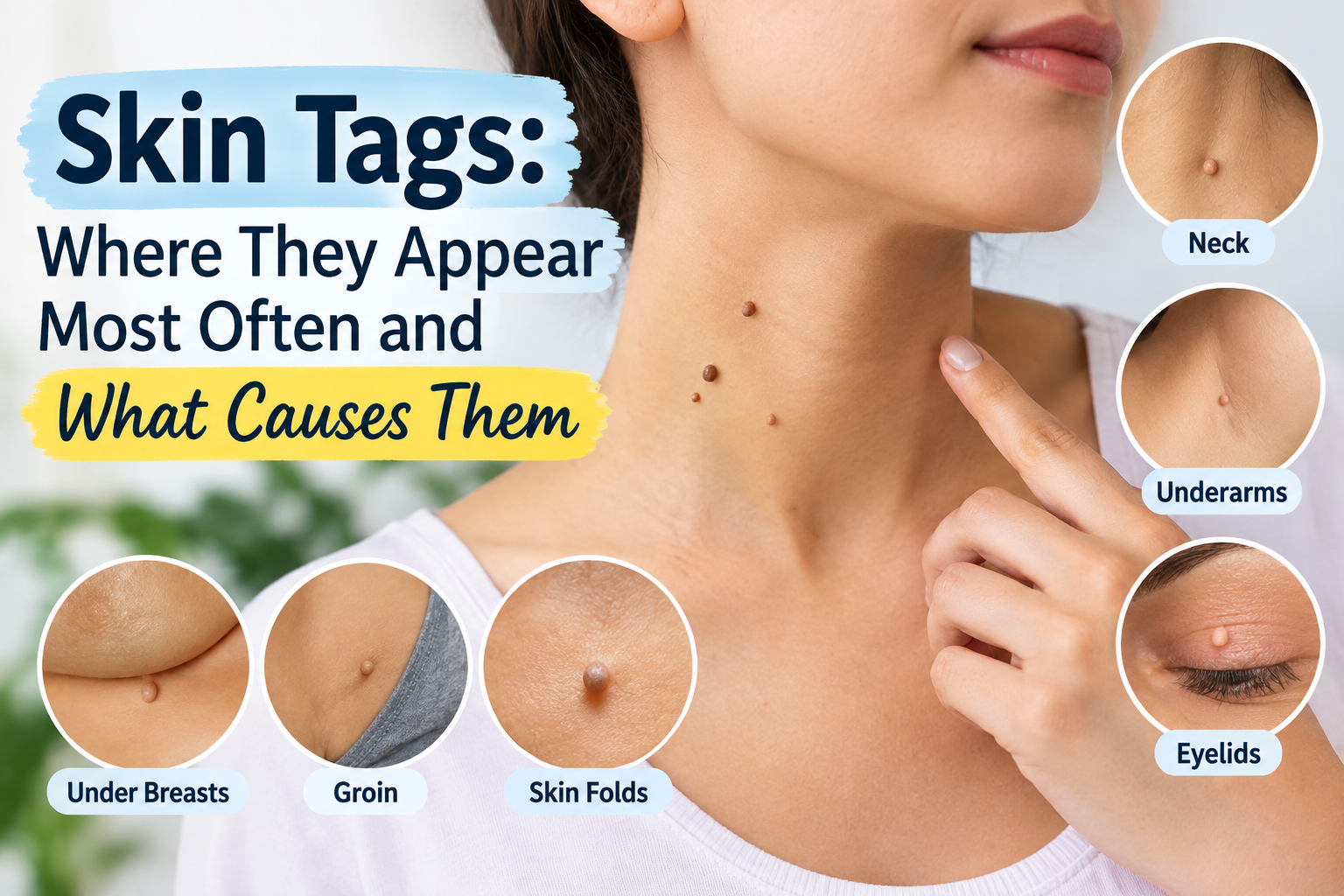
Finding a small, soft growth on your skin can be surprising, especially when you do not remember seeing it before. One common possibility is a skin tag, a generally harmless growth that can develop in different areas of the body.
Skin tags, medically known as acrochordons, are usually soft, flesh-colored growths that may hang from the skin by a small stalk. They are generally noncancerous and often cause no symptoms.
But why do they seem to appear in certain places more often than others?
The answer may have a lot to do with skin folds, repeated rubbing and irritation.
What Exactly Is a Skin Tag?
A skin tag is a small benign growth made up of skin and other tissue. They can vary in size, shape and color, although many are close to the surrounding skin tone.
Most skin tags are not dangerous. However, other skin growths can sometimes look similar, including warts, moles and some other skin conditions. That is why a new or unusual growth should not automatically be assumed to be a skin tag.
1. The Neck Is a Common Location
The neck is one of the areas where skin tags are frequently noticed.
Everyday movement can cause the skin to rub against itself, while collars, necklaces and other clothing or accessories may add additional friction. This repeated irritation may contribute to the development of skin tags.
They can be especially noticeable because the neck is an exposed area, meaning even a tiny growth may be easy to see.
2. Underarms Can Be Prone to Skin Tags
The underarm area naturally contains folds where skin can come into contact with other skin.
Movement of the arms creates repeated rubbing, while sweat and moisture can make the area more prone to irritation. Cleveland Clinic notes that skin tags commonly develop in areas where skin rubs together, including the armpits.
This does not mean every person with underarm skin tags has a particular medical problem. Skin tags can occur for several reasons, and their exact cause is not always known.
3. Groin and Other Skin Folds
The groin is another location where skin tags can occur.
This area experiences regular movement, skin-to-skin contact and friction from clothing. Similar conditions can occur around other body folds.
Because these areas can also become warm and moist, irritation may be more noticeable there.
4. Around the Eyelids
Small skin tags can also appear around the eyes.
The eyelid area is delicate, so even a small growth can become annoying or noticeable. Mayo Clinic lists the eyelids among common locations for skin tags.
Because the area is extremely sensitive, attempting to cut or remove a growth near the eye at home is particularly risky. Professional evaluation is the safer approach.
5. Under the Breasts
The skin beneath the breasts can experience both friction and moisture, especially where the skin forms a natural fold.
Clothing and movement can add to the rubbing in this area. As with other locations, a growth found here may be a skin tag, but an accurate diagnosis is important if its appearance is unusual.
Why Do Skin Tags Form in These Places?
There is no single confirmed cause for every skin tag.
However, medical sources identify several factors that may be associated with them.
Friction
Repeated rubbing between skin surfaces or between skin and clothing appears to play a role. This helps explain why skin tags are frequently found in areas such as the neck, armpits and body folds.
Age
Skin tags can become more common as people get older. Mayo Clinic notes that they may increase with age.
Genetics
Some people may be more likely to develop skin tags because of family or genetic factors.
Body Folds and Moisture
Areas where skin regularly touches skin can experience more friction and irritation. This is one reason certain body folds are common locations.
Metabolic Factors
Research has found associations between skin tags and conditions such as insulin resistance and Type 2 diabetes, although having skin tags does not by itself mean someone has diabetes.
It is important not to diagnose an underlying condition based solely on the presence of skin tags.
Are Skin Tags Dangerous?
Most skin tags are harmless and do not require treatment.
They may become bothersome if they repeatedly catch on jewelry, clothing or other objects. A tag that becomes irritated can sometimes bleed or become painful.
The important point is that not every bump or growth is necessarily a skin tag.
If you are unsure what a growth is, having it examined by a healthcare professional can help establish the correct diagnosis.
When Should You Have a Skin Growth Checked?
Consider speaking with a healthcare professional if a growth:
- Changes noticeably in appearance
- Starts bleeding without an obvious reason
- Becomes painful
- Grows quickly
- Becomes repeatedly irritated
- Looks different from your other skin tags
- Appears to be something other than a typical skin tag
A dermatologist can determine whether the growth is actually a skin tag or another type of skin lesion.
Should You Remove a Skin Tag Yourself?
It is tempting to search for quick home remedies, especially when a skin tag is small.
However, medical professionals generally recommend avoiding DIY removal. Cutting, burning or freezing a growth yourself can cause bleeding, infection, scarring or skin discoloration. More importantly, you could mistakenly remove something that is not actually a skin tag.
When removal is appropriate, a healthcare professional can use methods such as cutting, electrosurgery or cryotherapy.
The Bottom Line
Skin tags are common benign skin growths that can appear almost anywhere, but they are particularly common in places where skin rubs against skin or clothing.
The neck, underarms, groin, eyelids and areas beneath the breasts are among the locations where they may be noticed. Friction appears to be one contributing factor, while age, genetics and certain metabolic factors may also be associated with their development.
Most skin tags are harmless. Still, a new, rapidly changing, painful or bleeding growth deserves professional attention rather than an assumption that it is simply a skin tag.
Medical note: This article is for general educational information and is not a substitute for an examination or diagnosis by a qualified healthcare professional.