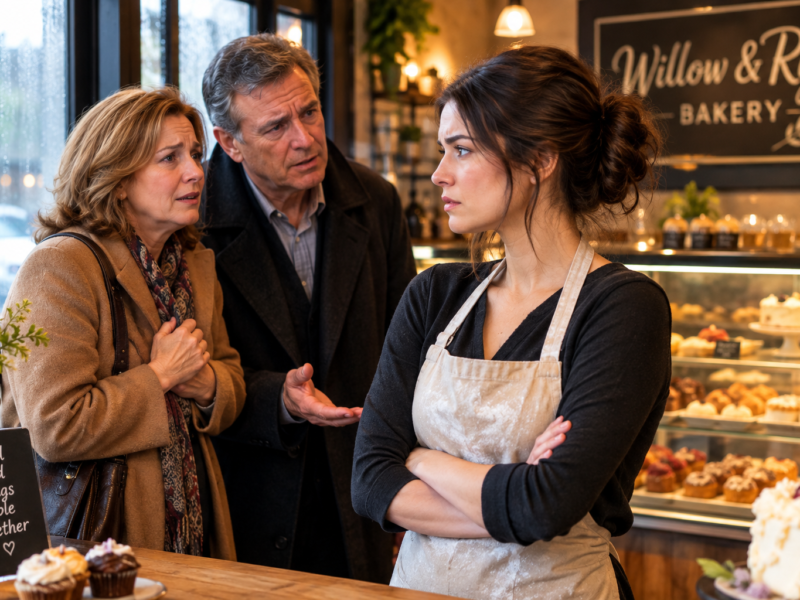
I used to believe my mother and my husband simply hated each other. Whenever they were in the same room, the atmosphere changed. My mother became cold and distant, while my husband, Daniel, suddenly found a reason to leave.
For years, I convinced myself that they were just two stubborn people who could never get along.
I never imagined their arguments were hiding a truth that had shaped my family long before I understood what secrets really meant.
My name is Emily Carter, and until the day of my mother’s funeral, I believed I knew everything important about my life.
I was wrong.
A Marriage My Mother Never Celebrated
When I introduced Daniel to my mother, Helen, I expected the usual questions about his job, his family, and our plans for the future.
Instead, she barely spoke to him.
After dinner, she pulled me into the kitchen and asked whether I was absolutely certain about marrying him.
I laughed, thinking she was being overprotective.
“Mom, you haven’t even given him a chance,” I told her.
She looked through the kitchen window toward the old garden behind our house.
“Sometimes, Emily, the people we love are the ones we understand the least.”
I asked what she meant, but she shook her head and changed the subject.
Daniel proposed three months later. My mother attended our wedding, smiled for the photographs, and hugged me goodbye. Yet she never once told Daniel she was happy for us.
As the years passed, their relationship grew stranger.
She refused to let him help with repairs around her house. He never accepted invitations to visit her alone. When I asked either of them what was wrong, I received the same answer.
“Nothing you need to worry about.”
I hated those words.
My mother had always been private, but after my father died, her garden became almost sacred to her. She spent hours tending the flowerbeds, trimming the hedges, and caring for a small stone fountain near the back fence.
There was one place she never allowed anyone to touch: a narrow patch of earth beneath an old stone bench.
Whenever I offered to clean it, she became unusually defensive.
“Leave that corner alone,” she would say.
I assumed it was connected to her grief.
I never asked again.
The Words I Heard at Her Funeral
My mother became seriously ill during the winter. The diagnosis came too late, and within weeks, our conversations turned from ordinary family matters to hospital visits and difficult goodbyes.
Daniel accompanied me whenever he could, but he and my mother barely exchanged words.
Even near the end, she seemed determined to keep her distance from him.
One evening, while I sat beside her bed, she held my hand and whispered, “There is something in the garden you must find.”
I leaned closer.
“What is it, Mom?”
Her eyes shifted toward the doorway, where Daniel stood silently.
For a moment, fear crossed her face.
“Not until the right time,” she murmured.
Before I could ask another question, exhaustion overtook her. She never explained what she meant.
My mother died two days later.
At the funeral, relatives filled the church, sharing memories of her kindness and her quiet determination. Daniel stood beside me throughout the service, holding my hand whenever my grief became too much to bear.
Then, just before the final prayers, I noticed him disappear.
I found him outside near the church parking lot, speaking to an elderly man I had never seen before.
When the stranger left, I approached Daniel.
“Who was that?”
He looked startled.
“An old acquaintance of your mother’s.”
“What did he want?”
Daniel hesitated before answering.
“He wanted to know whether she had finally told you.”
My stomach tightened.
“Told me what?”
Daniel looked toward the road rather than meeting my eyes.
“I can’t explain it here.”
For the first time in our marriage, I felt that my husband was not simply avoiding a difficult conversation. He was deliberately keeping part of my life hidden from me.
A Discovery Beneath the Stone Bench
That evening, after the guests had gone home, I returned to my mother’s house alone.
Her garden looked painfully ordinary beneath the fading daylight. The flowers were still blooming, and the fountain still trickled softly, just as it had when she was alive.
I remembered her final words.
There is something in the garden you must find.
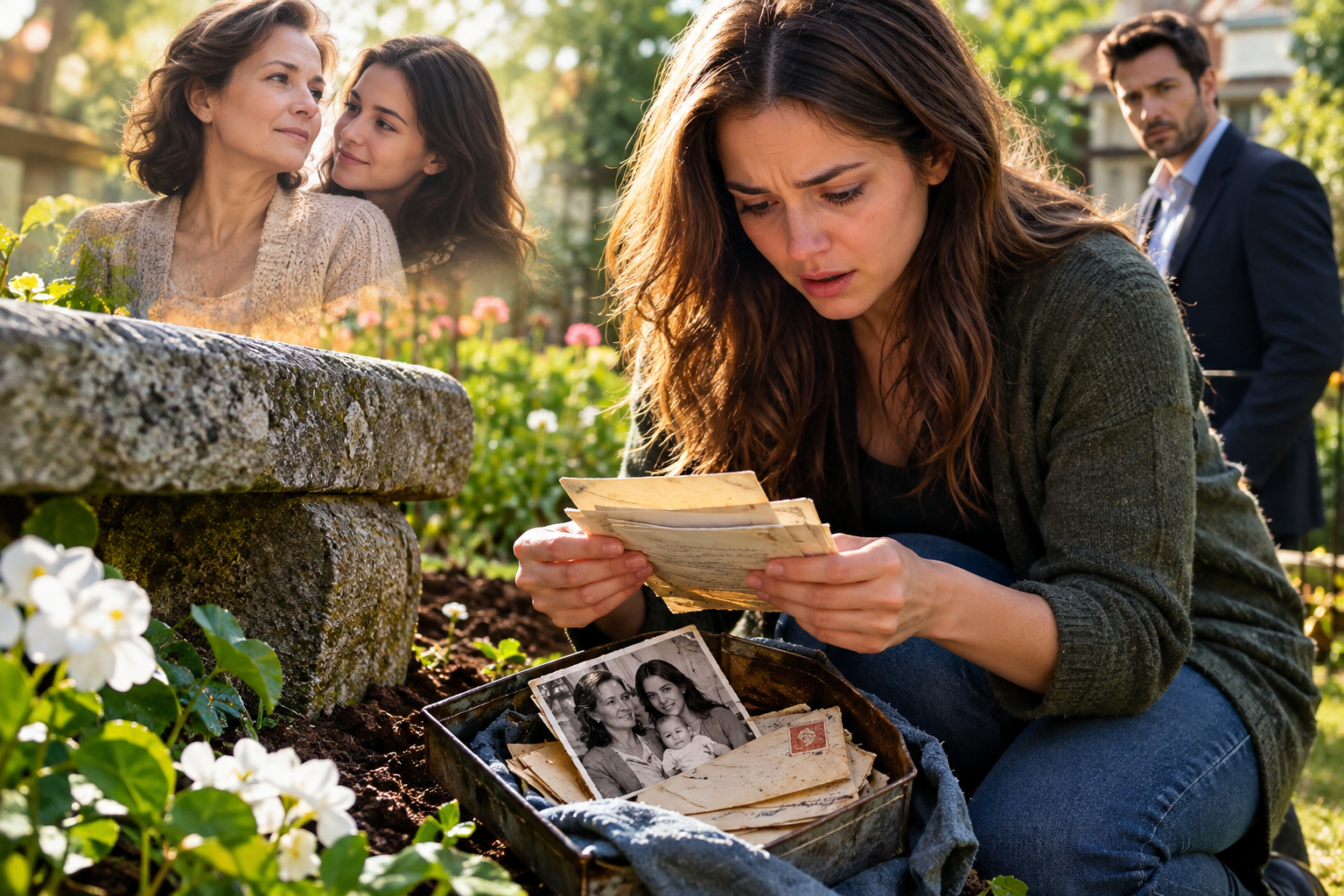
I searched the flowerbeds until I reached the stone bench near the back fence.
The earth beneath it was unusually loose.
I found a small metal container wrapped in an old piece of waterproof fabric. Inside lay several letters, a faded photograph, and a sealed envelope bearing my name.
My hands trembled as I opened the first letter.
It was dated thirty-one years earlier, several months before my birth.
The letter had been written by a woman named Laura Bennett, someone I had never heard of.
She explained that she and my mother had been close friends when they were young. They had shared an apartment, worked at the same local hospital, and dreamed of building better lives.
Then came a sentence that made me sit down on the cold stone path.
“Your mother promised to protect my child if anything happened to me.”
I read it twice.
My mother had been twenty-four years old when that letter was written. I was born the following year.
Was Laura connected to my birth?
Why had my mother hidden her letters?
And why had Daniel reacted as though he already knew about them?
At the bottom of the container lay a photograph of two young women standing beside a hospital window. One was unmistakably my mother.
The other held a newborn wrapped in a pale blanket.
On the back, my mother had written four words:
“The promise must survive.”
The Truth Daniel Had Carried for Years
I drove home with the letters beside me and found Daniel waiting in the kitchen.
I placed the photograph on the table.
“Tell me who Laura Bennett was.”
His face changed immediately.
For several seconds, neither of us spoke.
Then he pulled out a chair and sat down.
“Your mother asked me never to tell you unless you found those letters yourself,” he said.
I stared at him in disbelief.
“You knew about this?”
“Yes.”
“Since when?”
“Since before we got married.”
The room seemed to tilt around me.
Daniel explained that he had met Laura years earlier while volunteering with a community legal-aid organization. Before she died, Laura had asked him to help locate a missing relative and deliver a collection of personal documents to my mother.
He had never expected to become part of the family.
But when he met me, he recognized my mother’s name from the documents Laura had entrusted to him. He contacted my mother privately, hoping to understand the connection before saying anything.
My mother had been furious.
She feared that revealing the past would destroy the family she had worked so hard to protect.
“That explains why she disliked you,” I whispered.
Daniel shook his head.
“She didn’t dislike me because of who I was. She was afraid I would uncover something she had spent her whole life trying to keep safe.”
I opened the envelope addressed to me.
Inside was a letter written in my mother’s familiar handwriting.
It explained that Laura had given birth to a little girl but had been unable to care for her after a serious family crisis. My mother had helped arrange a private guardianship with a trusted relative.
The letter did not say that I was adopted, nor did it identify Laura as my biological mother. It was a promise to protect a child, not proof of a secret about my own birth.
That distinction mattered.
For the first time, I understood how easily grief and unanswered questions could turn suspicion into certainty.
But one question remained.
Why had my mother hidden the letters beneath the bench instead of simply telling me about her friend?
The Last Letter
The final envelope contained a more recent letter, written just months before my mother became ill.
In it, she explained that Laura’s daughter had grown up believing her biological family had abandoned her. My mother had kept the original documents because she believed the young woman deserved to know the truth when she was ready.
Daniel had discovered that the woman was searching for her family. He wanted to help, but my mother insisted that the decision had to belong to the woman herself.
Their arguments had never been about hatred.
They had been about whether silence was protection or another form of harm.
My mother believed waiting would spare everyone pain. Daniel believed people deserved the opportunity to make their own choices.
Neither had wanted me caught between them.
Yet by keeping me in the dark, they had made me part of the secret without my consent.
The letter ended with a sentence I read again and again:
“Emily, love can give us a reason to protect the truth, but it cannot give us the right to own it forever.”
I began to cry.
I had spent years blaming my mother for being cold toward my husband. I had blamed Daniel for never making a genuine effort to repair their relationship.
The truth was more complicated than either accusation.
They had both been trying to do what they thought was right, and both had underestimated the cost of keeping silent.
What I Chose to Do Next
The following morning, Daniel and I returned to the garden.
We placed the letters, photograph, and documents in a folder and contacted the organization mentioned in my mother’s correspondence. With their guidance, we began looking for a respectful way to pass the information to Laura’s daughter without exposing private details unnecessarily.
I also made a decision about my own marriage.
I told Daniel that I loved him, but love could not be an excuse for years of unexplained secrecy.
“If something affects our family, I need you to talk to me,” I said. “Even when the truth is uncomfortable.”
He apologized without defending himself.
It was not an instant solution. Trust, once shaken, takes time to rebuild. But it was a beginning.
Weeks later, I planted white flowers beside the old stone bench. I kept the garden because it had been my mother’s refuge, not because I wanted to preserve her secrets.
Sometimes I still wish she had told me everything while she was alive. I wish we had sat together in that garden and discussed the difficult things instead of allowing silence to grow between us.
But I have stopped imagining that every unanswered question must have a terrible answer.
My mother’s garden taught me something I had never understood before: buried things do not always disappear. Sometimes they wait for someone brave enough to bring them into the light.
And the greatest act of love is not always protecting someone from the truth.
Sometimes, it is trusting them enough to let them face it.
The End.