When my grandmother Eleanor passed away, I expected to inherit nothing.
My parents had always told me that Grandma’s house, savings, and belongings would eventually be divided among the family. I never argued about it. I wasn’t interested in money.
What I wanted was the old recipe book she used every Sunday and the little wooden music box that had sat beside her bed for as long as I could remember.
But during the reading of her estate documents, the attorney looked directly at me.
“There is one unusual provision,” she said.
Everyone in the room became quiet.
Grandma had left me something very specific.
Not her house.
Not her savings.
Not even her jewelry.
She had left me the contents of Room 3B in the basement of her old farmhouse.
There was only one problem.
Nobody in the family knew what Room 3B was.
The Room Nobody Talked About
The farmhouse had a basement, but I had never heard anyone call a section of it Room 3B.
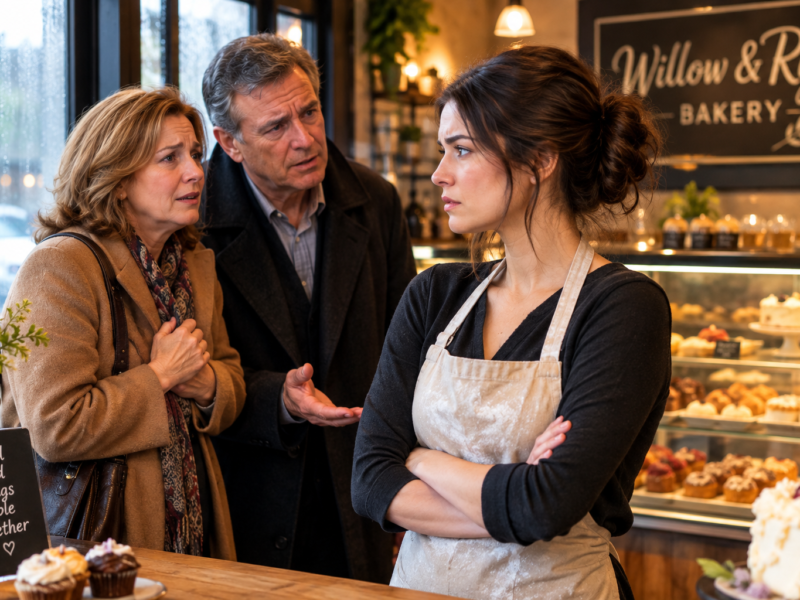
My father immediately objected.
“That room doesn’t belong to her,” he said.
The attorney calmly opened the estate folder.
“According to the property records, Mrs. Eleanor maintained a separate storage room that was specifically excluded from the general estate distribution. Her instructions are very clear.”
My father stopped talking.
I noticed something strange.
He looked frightened.
Not angry.
Frightened.
That was the moment I realized Grandma hadn’t created this arrangement by accident.
Two days later, I returned to the farmhouse.
The basement smelled of dust, old wood, and the lavender soap Grandma always used.
Behind a row of wooden shelves, I found a narrow door.
There was no room number.
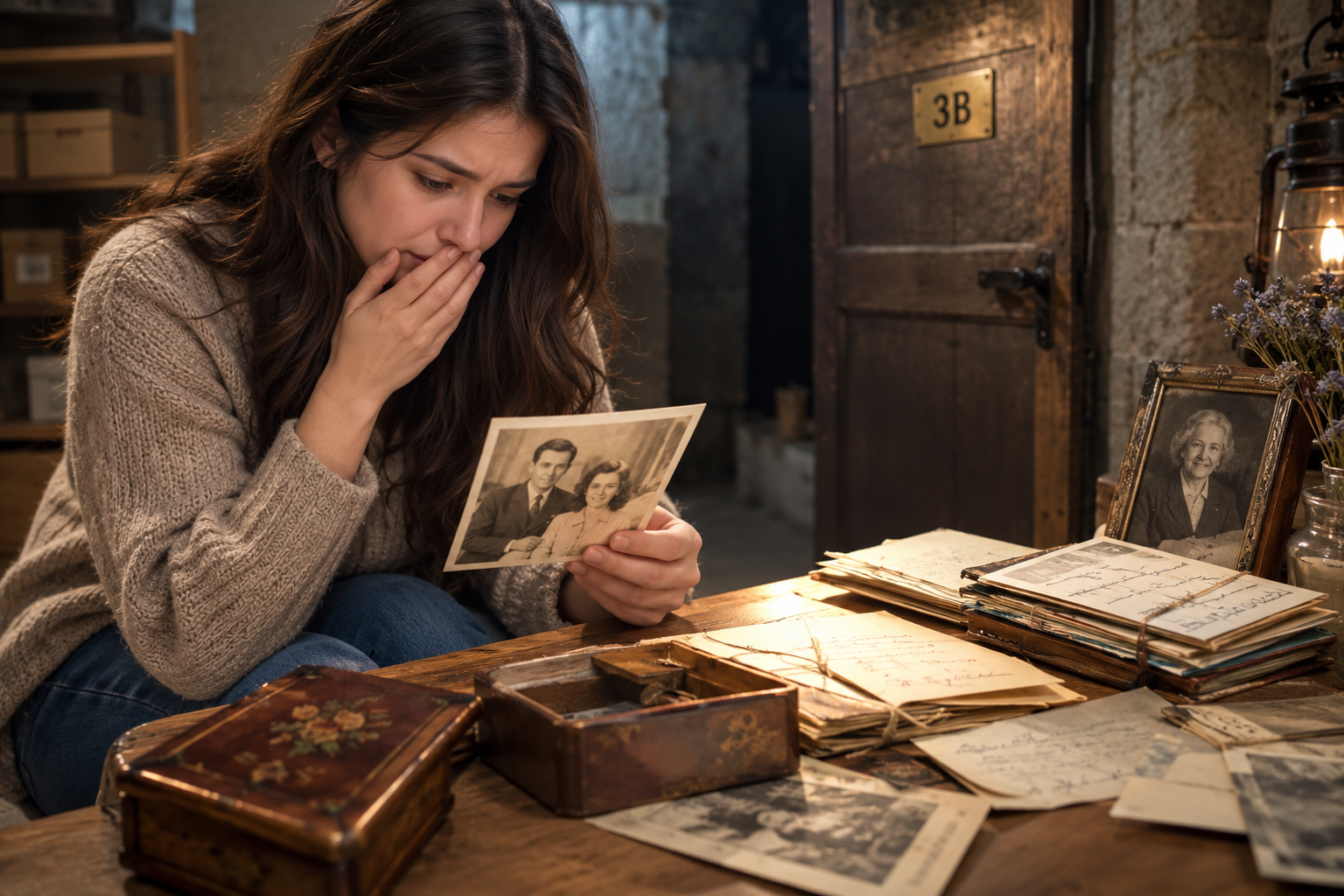
Only a small brass plate with the letters 3B.
My hands began to shake.
The key from the attorney’s envelope fit perfectly.
The Box on the Wooden Table
Inside was a tiny room filled with old photographs, envelopes, notebooks, and several cardboard boxes.
Nothing looked valuable.
Then I saw the photograph on the table.
It showed my grandmother as a young woman standing beside a man I had never seen before.
On the back, Grandma had written:
“The person who knows why our family story changed.”
I spent the next hour looking through everything.
There were letters dating back more than forty years.
Most were between Grandma and a woman named Margaret.
At first, I assumed Margaret was an old friend.
Then I found a letter that made my stomach drop.
Margaret was actually my father’s biological mother.
My grandmother had never told anyone.
A Family Secret From Before I Was Born
According to the letters, my father had been adopted as a baby.
Grandma had raised him with her husband, but the adoption had remained a secret.
The shocking part wasn’t the adoption itself.
It was why it had happened.
Margaret had been struggling financially and had been pressured by her own relatives to give up her child.
Grandma and Grandpa had stepped in and promised to protect the baby.
But years later, Margaret returned.
She wanted contact with her son.
Grandma allowed occasional meetings but kept the truth hidden because she feared the family would fall apart.
Then I found something even more disturbing.
A second folder contained financial records.
Grandma had secretly placed money into an account intended for my father.
But someone had been withdrawing from it for years.
The withdrawals weren’t made by Grandma.
They were authorized using my father’s name.
The Signature That Didn’t Look Right
I took the documents to the attorney who had handled Grandma’s estate.
She examined them carefully.
“These signatures need to be verified,” she said.
A handwriting specialist later confirmed that several signatures did not match my father’s genuine handwriting.
Someone had been accessing the account without his knowledge.
We traced the paperwork back through old bank records.
The person connected to the withdrawals wasn’t my father.
It was my uncle.
For years, he had convinced everyone that Grandma was giving him money to manage her medical expenses.
She wasn’t.
He had been taking money from an account that Grandma had created for her son.
The total wasn’t the fortune everyone imagined.
But it was enough to explain why Grandma had spent her final years worrying about money despite owning valuable property.
Why Grandma Chose Me
I eventually found the final letter.
It was addressed to me.
Grandma explained that she had chosen me because I was the only person in the family who had never asked her how much money she had.
She wrote that she didn’t want me to inherit wealth without understanding the people and sacrifices behind it.
Her greatest concern wasn’t the money.
It was that the family had become so obsessed with possessions that they had forgotten what loyalty meant.
She also explained why she had never revealed my father’s adoption.
She had hoped that one day the truth could come from him rather than from a document.
But she had run out of time.
The Conversation With My Father
I didn’t know what to do.
For several days, I kept the documents locked away.
Eventually, I asked my father to meet me.
I didn’t accuse him of anything.
I simply placed the photograph on the table.
He stared at it for almost a minute.
Then he whispered:
“Where did you find this?”
I told him about Room 3B.
He closed his eyes.
For the first time, my father told me the truth.
He had always suspected he was adopted.
He had once found an old hospital document as a teenager, but when he asked his parents about it, they denied everything.
He had spent decades wondering whether the people he called his parents had ever truly wanted him.
My grandmother’s letter finally answered that question.
They had.
They had simply been afraid.
The Decision That Changed Everything
My uncle initially denied everything.
But when the financial records were reviewed, the evidence became impossible to ignore.
He agreed to repay the money rather than continue the dispute.
My father also decided to contact Margaret’s family.
He discovered that she had passed away several years earlier, but she had left behind letters of her own.
For the first time, my father learned what his biological mother had wanted all those years ago.
She had never abandoned him because she didn’t love him.
She had believed she had no other choice.
That discovery changed my father more than the inheritance ever could.
What I Actually Inherited
In the end, I received the small farmhouse room, Grandma’s belongings, and a modest financial inheritance.
But the most valuable thing she left me wasn’t money.
It was the truth.
I used part of the inheritance to restore the farmhouse and turn the old basement room into a small community archive where local families could preserve photographs, letters, and personal histories.
The wooden table from Room 3B still sits in the center.
Grandma’s music box is on a shelf above it.
And every time I hear its little melody, I think about the lesson she left behind.
Families aren’t held together by blood, property, or bank accounts.
Sometimes they survive because someone chooses to tell the truth.
And sometimes the inheritance that changes your life isn’t the one written in a will.
It’s the truth waiting to be discovered.
Final Takeaway
If your family has old documents, photographs, letters, or stories that seem insignificant, don’t assume they have no value. Personal history can reveal relationships and circumstances that younger generations may never have known.
The most meaningful inheritance isn’t always something you can put in a bank.
Sometimes, it’s an answer to a question your family has been afraid to ask