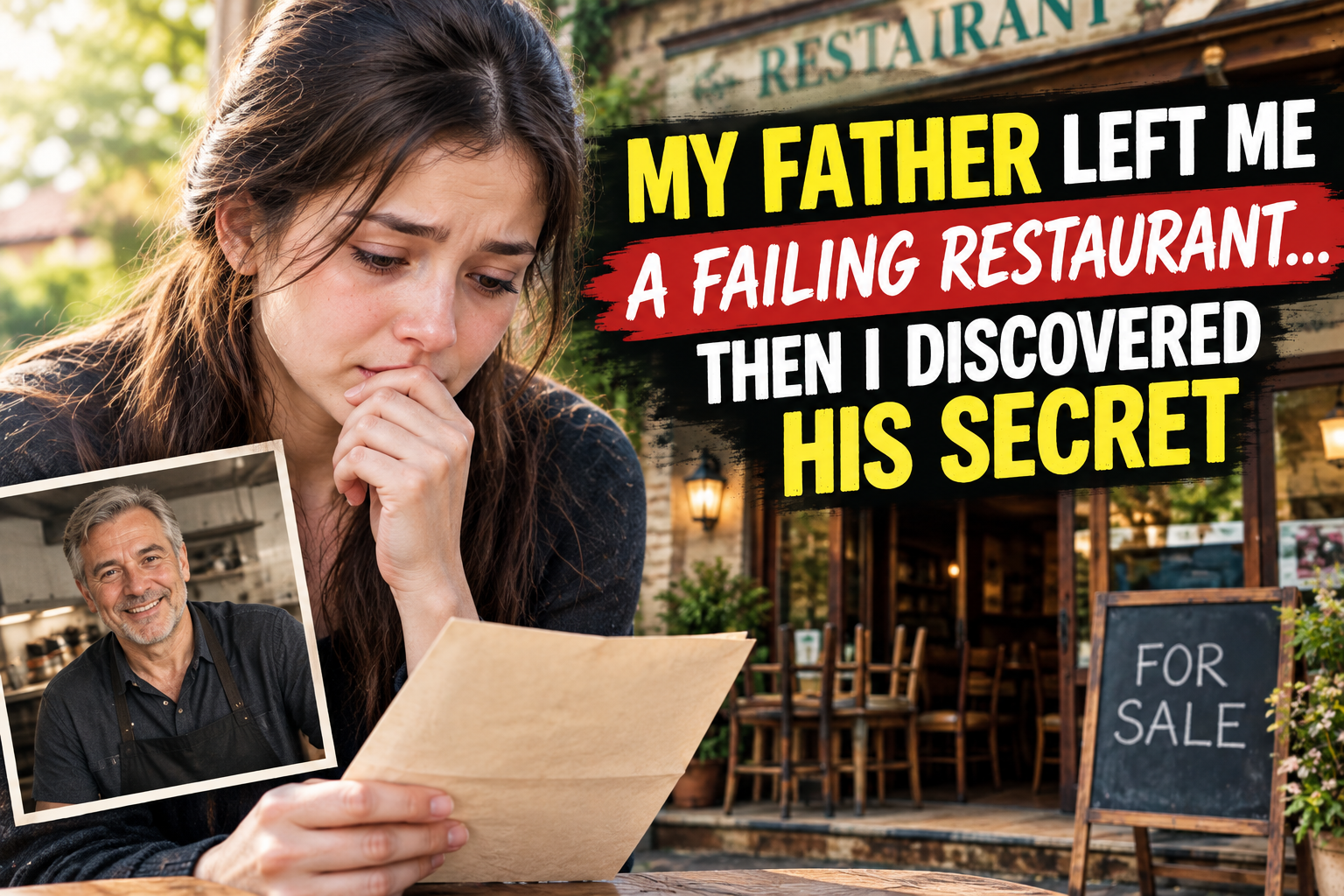
When my father died, he left me a restaurant I had spent years trying to convince him to sell.
The place was almost empty.
The paint was peeling.
The kitchen equipment was old.
There were bills stacked inside a drawer behind the counter.
I thought he had left me a burden.
I was wrong.
Three weeks after his funeral, an elderly woman walked into the restaurant and asked me a question that changed everything.
“Are you Daniel’s daughter?”
I nodded.
She looked around the dining room and started crying.
“Then you need to know what your father did here.”
I had no idea what she meant.
Until she told me the truth.
The Restaurant I Never Wanted
My father’s name was Daniel.
He had owned a small neighborhood restaurant called Harbor Table for almost twenty-five years.
I grew up above that restaurant.
The smell of onions frying in the kitchen was practically the smell of my childhood.
But I never loved the business the way he did.
When I went to college, I moved away.
I studied graphic design and built a career in another city.
My father stayed behind.
Whenever I visited, I would tell him the same thing.
“You should sell this place.”
He always smiled.
“And do what?”
“Travel. Relax. Enjoy your life.”
He would shake his head.
“One day you’ll understand.”
I never did.
The Final Conversation
Six months before his death, I visited him.
The restaurant was struggling.
There were only three customers during the entire evening.
I looked around at the empty tables.
“Dad, seriously. You can’t keep doing this.”
He was wiping a glass behind the counter.
“I’m fine.”
“No, you’re not.”
He smiled.
“You’ve always been dramatic.”
“I’m serious.”
“So am I.”
He put the glass down.
“Some things are worth keeping even when they don’t make money.”
I didn’t understand.
“That’s exactly why you should sell it.”
He looked at me for several seconds.
Then he said:
“Maybe someday you’ll find out.”
Those were the last words we ever argued about.
The Inheritance
After his funeral, I returned to town to deal with everything.
The restaurant was mine.
So were the debts.
I hired an accountant.
She looked through the numbers and gave me the same advice I had given my father for years.
“Sell it.”
I agreed.
I contacted a commercial real estate agent.
Within days, a buyer came to inspect the property.
He offered a decent price.
I was ready to sign.
Then someone knocked on the restaurant door.
It was an elderly woman carrying a small paper bag.
“Is this Daniel’s daughter?”
“Yes.”
She smiled sadly.
“My name is Mrs. Alvarez.”
She handed me the bag.
Inside was a handwritten recipe card.
“Your father made this for my husband every Friday.”
I looked at the recipe.
“What does this have to do with the restaurant?”
She stared at me.
“Everything.”
The First Secret
Mrs. Alvarez sat at one of the tables.
She told me her husband had lost his job fifteen years earlier.
They couldn’t afford groceries.
Daniel had quietly started giving them meals.
At first, he told them it was a mistake.
Then it became a weekly tradition.
“He never charged us,” she said.
I was stunned.
“My father never told me that.”
“He wouldn’t.”
“Why?”
She smiled.
“Because he didn’t want anyone to know.”
Then she said something that made me look around the restaurant differently.
“Your father wasn’t running this place for the reasons you thought.”
The Notebook
That evening, I searched my father’s office.
I found old receipts.
Tax documents.
Supplier invoices.
Nothing unusual.
Then I opened the bottom drawer.
Inside was a black notebook.
On the first page, my father had written:
People who need a meal.
Underneath were dozens of names.
Families.
Older people.
Single parents.
Students.
Beside each name were dates.
And amounts.
Some entries said:
Dinner — paid by Daniel.
Others said:
Groceries — no charge.
I sat on the floor.
For twenty-five years, I had believed my father was stubbornly holding onto a failing restaurant.
I had never realized he was using it to quietly help people.
The Man at Table Seven
The next morning, a middle-aged man walked in.
He looked nervous.
“Are you Daniel’s daughter?”
I was beginning to hate that question.
“Yes.”
He pointed toward a table.
“Can I sit there?”
“Of course.”
He sat at Table Seven.
Then he told me his story.
When he was seventeen, his mother had become seriously ill.
His family had almost nothing.
He used to come to the restaurant after school.
My father fed him.
Every day.
For almost a year.
“He never asked for money,” the man said.
I looked at the notebook.
“What happened to you?”
“I became a teacher.”
He smiled.
“And every year, I bring my best students here.”
I didn’t know what to say.
The Real Reason Dad Kept the Restaurant
Over the next few days, more people came.
A woman whose husband had died.
A college student who had once slept in his car.
A retired mechanic.
A young couple with three children.
They all had the same story.
At some point in their lives, my father had helped them.
Quietly.
Without publicity.
Without social media posts.
Without asking anyone to thank him.
I finally understood his words.
Some things were worth keeping even when they didn’t make money.
He hadn’t been measuring the restaurant’s success in dollars.
He had been measuring it in people.
The Buyer Returned
The buyer came back on Friday.
“Have you decided?”
I looked at the contract on my desk.
For weeks, selling the restaurant had seemed like the obvious choice.
Now it felt different.
“I’m not selling.”
He frowned.
“You realize the business is losing money?”
“I know.”
“Then why keep it?”
I looked toward the dining room.
Because for the first time, I finally understood my father.
“Because I just discovered what my father built.”
Starting Again
Keeping the restaurant wasn’t easy.
I couldn’t simply continue operating the way my father had.
The bills were real.
The rent was real.
The staff needed salaries.
So I changed the business without changing its purpose.
I redesigned the menu.
Created a simple website.
Started weekend community dinners.
Partnered with local farmers.
And introduced a program called The Open Table.
Customers could pay for an extra meal.
That meal would be given to someone who needed it.
At first, only a few people participated.
Then dozens did.
Then local businesses joined.
The restaurant slowly became busy again.
But something had changed.
I wasn’t trying to make it famous.
I was trying to make it useful.
The Last Page
Six months after taking over the restaurant, I found another notebook in my father’s office.
This one was much smaller.
There was only one sentence on the first page.
“If Emma ever takes over, don’t tell her what this place means. Let her discover it herself.”
I started laughing.
Then I started crying.
Even after he was gone, my father had found a way to surprise me.
At the bottom of the page, he had written:
“The best things in life are not always the things you can put on a balance sheet.”
I closed the notebook.
For the first time, I understood why he had never sold the restaurant.
One Year Later
A year after my father’s death, Harbor Table was still standing.
The walls had been painted.
The broken chairs were replaced.
The kitchen had new equipment.
But I kept one thing exactly as it was.
Table Seven.
The table where that teenage boy had once eaten meals he couldn’t afford.
The table where my father had quietly helped people who had nowhere else to go.
Above it, I placed a small wooden sign.
It said:
“Everyone deserves a seat.”
What My Father Taught Me
I used to think my father had failed because his restaurant never became a huge business.
Now I realize I was measuring success the wrong way.
He didn’t build a restaurant that made him rich.
He built a place where people felt less alone.
He fed people when they were hungry.
He helped families when they were struggling.
He gave people dignity without making them ask for it.
And somehow, without realizing it, he had taught me the most important lesson of my life.
Success isn’t always about how much you earn.
Sometimes it’s about how much good remains after you’re gone.
My father left me a failing restaurant.
I thought I had inherited a problem.
Instead, I inherited his purpose.
And I finally understood what he meant all those years ago.
Some things are worth keeping even when they don’t make money.

