When people think about foods that support the brain, they often mention berries, leafy greens, fish, and olive oil. But nuts deserve a place in that conversation too.
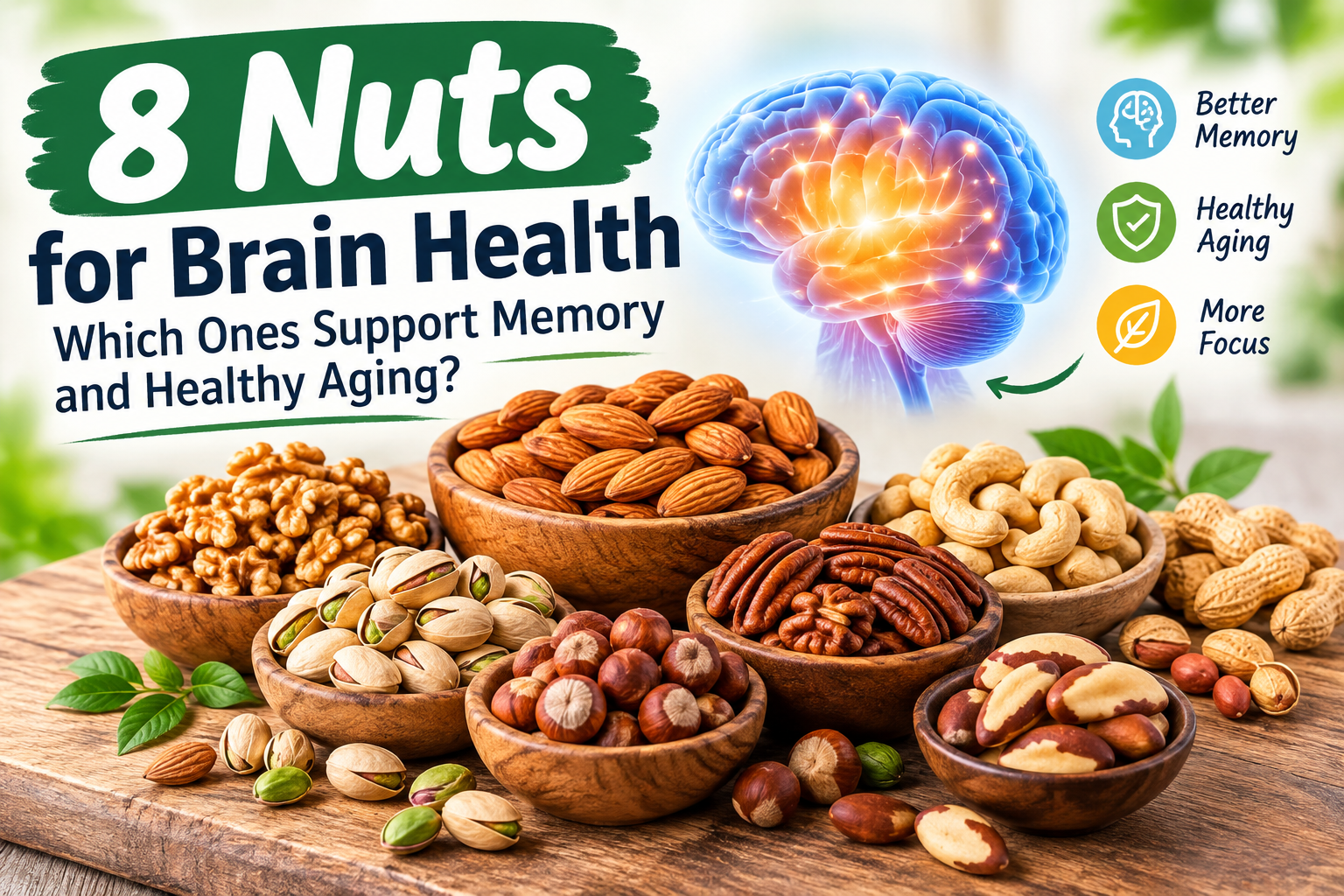
Nuts provide a combination of unsaturated fats, plant protein, fiber, vitamins, minerals, and antioxidant compounds. Researchers have studied several varieties—including walnuts, almonds, hazelnuts, pistachios, peanuts, pecans, cashews, and Brazil nuts—for possible connections with cognitive health.
However, there is an important distinction between supporting a healthy diet and claiming that a particular food can prevent dementia. Current research does not prove that eating a specific nut can prevent dementia, and clinical-trial evidence on nuts and overall cognitive performance remains mixed.
So rather than labeling certain nuts as “bad for the brain,” it is more useful to understand which nuts offer valuable nutrients, what the research actually shows, and how preparation and portion size can change their nutritional value.
1. Walnuts
Walnuts are one of the most frequently studied nuts when it comes to cognitive health.
They contain alpha-linolenic acid (ALA), a plant-based omega-3 fatty acid, along with polyphenols and other nutrients. A systematic review found that research specifically examining walnuts was more consistently favorable than research on mixed nuts, although the authors emphasized that stronger studies are still needed.
Walnuts can therefore be a useful addition to a balanced eating pattern.
Simple idea: Add a small portion of walnuts to oatmeal, yogurt, fruit, or a salad.
2. Almonds
Almonds are particularly well known for their vitamin E content, healthy unsaturated fats, magnesium, fiber, and protein.
Vitamin E acts as an antioxidant, while the combination of fat, protein, and fiber can make almonds a filling snack. Research investigating almonds and cognition has produced mixed results, so almonds should be viewed as a nutrient-dense food rather than a guaranteed memory enhancer.
Simple idea: Choose unsalted almonds as a snack instead of highly processed snack foods.
3. Hazelnuts
Hazelnuts provide healthy fats, vitamin E, folate, and plant compounds such as polyphenols.
Their nutritional profile makes them a practical choice for people looking to add more nutrient-dense foods to their diet. While research on individual nuts is still developing, hazelnuts can contribute to an overall healthy dietary pattern.
Simple idea: Sprinkle chopped hazelnuts over plain yogurt or add them to a homemade trail mix.
4. Pecans
Pecans contain unsaturated fats, fiber, minerals, and antioxidant compounds.
They can be particularly useful when eaten in their minimally processed form. The biggest nutritional advantage comes from using them as a replacement for less nutritious snack foods—not from treating pecans as a stand-alone treatment for memory problems.
Simple idea: Use a small amount of pecans in salads, oatmeal, or whole-grain dishes.
5. Pistachios
Pistachios offer protein, fiber, unsaturated fats, potassium, and several micronutrients.
They can make a satisfying snack, particularly when eaten with their natural shells or purchased without added salt. The preparation matters because heavily salted varieties can substantially increase sodium intake.
Rather than avoiding pistachios completely, look for unsalted or lightly salted options.
Simple idea: Keep a small portion available for an afternoon snack.
6. Peanuts
Although peanuts are technically legumes rather than tree nuts, they are commonly grouped with nuts because their nutritional profile is similar.
Peanuts provide protein, unsaturated fats, fiber, and several vitamins and minerals. Research involving peanuts and other nuts has investigated potential relationships with cognitive performance, but results across studies are not consistent enough to say that peanuts directly prevent cognitive decline.
One practical consideration is storage. Nuts and peanuts should be kept properly to reduce the risk of spoilage or mold contamination.
Simple idea: Choose natural or dry-roasted peanuts without excessive salt or added sugar.
7. Cashews
Cashews provide unsaturated fats, copper, magnesium, protein, and other nutrients.
They can fit comfortably into a balanced diet, but preparation is important. A plain or dry-roasted variety is generally more useful nutritionally than a version covered in sugar, heavily salted, or combined with highly processed ingredients.
Cashews should be considered one component of a healthy diet rather than a special food that can independently protect the brain.
Simple idea: Add a small serving to a vegetable stir-fry or homemade snack mix.
8. Brazil Nuts
Brazil nuts are unusual because they contain exceptionally high amounts of selenium.
Selenium is an essential mineral involved in several important biological processes, but more is not necessarily better. Because Brazil nuts can contain large amounts of selenium, eating very large quantities regularly is unnecessary and can potentially lead to excessive intake.
For this reason, Brazil nuts are better treated as a small-portion food rather than a snack to consume by the handful every day.
Simple idea: Include them occasionally in a varied diet rather than relying on large servings.
What About Nuts That Are “Bad” for the Brain?
This is where many online articles oversimplify the science.
There is not strong evidence showing that ordinary walnuts, almonds, pistachios, cashews, or other common nuts directly damage the brain when eaten as part of a normal diet.
The bigger concerns are usually related to how nuts are prepared, stored, and consumed.
For example:
Highly salted nuts
Large amounts of sodium can make it harder to maintain a healthy overall diet, particularly for people who need to manage sodium intake.
Sugar-coated nuts
Candy-coated or heavily sweetened nuts can turn a nutritious food into a much higher-sugar snack.
Deep-fried nut products
Cooking methods and added oils can substantially change the nutritional profile of a food.
Spoiled or improperly stored nuts
Nuts should be stored properly and discarded if they develop an unusual smell, taste, visible mold, or other signs of spoilage.
How Many Nuts Should You Eat?
There is no single perfect amount for everyone because nutritional needs vary according to age, activity level, total calorie intake, and health circumstances.
A practical approach is to use a small handful as a snack or serving, while keeping the rest of your diet varied.
Nuts are calorie-dense, so eating large quantities can add substantial calories even though the food itself is nutritious.
Instead of asking, “Which nut is the best?” a better question is:
“How can I regularly include a variety of minimally processed nuts in an overall healthy diet?”
Do Nuts Actually Prevent Dementia?
This claim deserves caution.
Research has found associations between nut consumption and certain cognitive outcomes, and walnuts have received particular attention. However, systematic reviews have also pointed out inconsistencies between studies.
More recently, a systematic review and meta-analysis of randomized clinical trials found no statistically significant overall improvement in cognitive function from nut consumption. The researchers included five trials involving 928 adults and concluded that larger, higher-quality trials are needed.
That means nuts can reasonably be part of a brain-friendly eating pattern, but it would be misleading to describe any particular nut as a proven dementia-prevention treatment.
The Bigger Picture: Your Entire Diet Matters
Brain health is influenced by many factors, not just one food.
A balanced eating pattern can include:
- Vegetables and leafy greens
- Fruits and berries
- Whole grains
- Beans and legumes
- Fish and other protein sources
- Unsaturated fats
- Nuts and seeds
- Adequate hydration
Regular physical activity, sufficient sleep, management of cardiovascular risk factors, and avoiding tobacco are also important parts of healthy aging.
This is why adding a few walnuts to an otherwise poor diet is unlikely to transform brain health by itself.
Final Takeaway
Nuts can be a convenient and nutrient-rich part of a balanced diet. Walnuts, almonds, hazelnuts, pecans, pistachios, peanuts, cashews, and Brazil nuts all provide different combinations of nutrients.
The strongest practical strategy is not to search for one “miracle nut.” Instead, choose a variety of minimally processed nuts, watch portion sizes, limit heavily salted or sugar-coated versions, and combine them with an overall healthy eating pattern.
Current research suggests that nuts are worth including in a nutritious diet, but evidence is not strong enough to claim that any specific nut can prevent dementia.
Your brain benefits from the whole lifestyle—not one food alone.
Frequently Asked Questions
Which nut is commonly studied for brain health?
Walnuts have been studied extensively in relation to cognitive outcomes, although researchers say more high-quality evidence is needed before firm conclusions can be made.
Are nuts good for memory?
Nuts provide nutrients associated with healthy eating patterns, but research has not established that eating nuts alone directly improves memory in everyone.
Can nuts prevent dementia?
There is currently not enough evidence to say that a particular nut prevents dementia. Randomized-trial evidence on overall cognitive benefits remains mixed.
Are salted nuts healthy?
Salted nuts can still contain valuable nutrients, but choosing unsalted or lightly salted varieties can help reduce sodium intake.
Should Brazil nuts be eaten every day?
Brazil nuts contain a very high amount of selenium compared with many other foods, so very large servings should be avoided.
What is the healthiest way to eat nuts?
Choose raw or dry-roasted nuts with little or no added salt, sugar, or heavily processed coatings, and keep portions moderate.