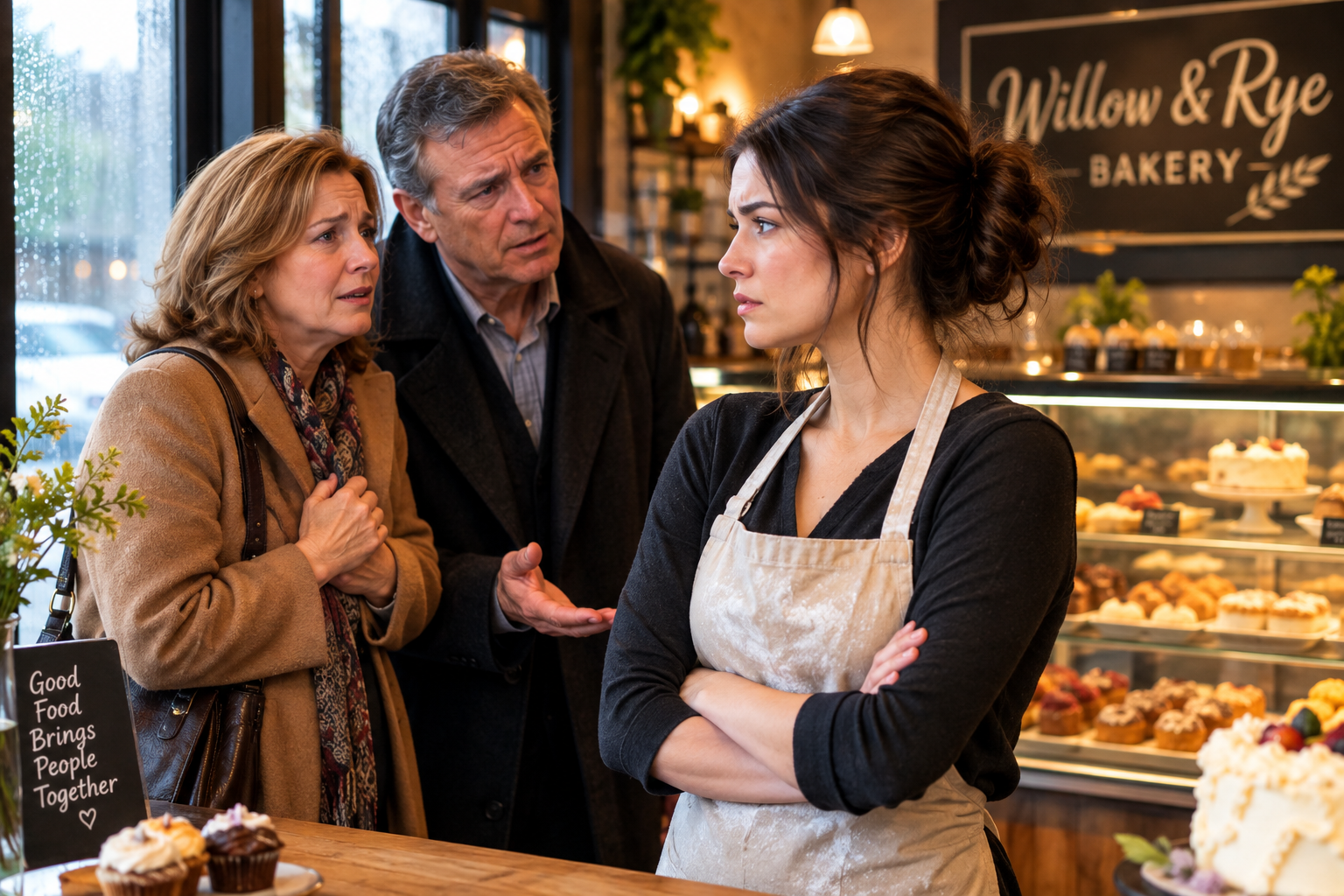
The bell above my bakery door rang at 6:17 on a rainy Tuesday morning.
I was standing behind the counter, still wearing my flour-covered apron, when I looked up and saw two people I hadn’t seen in almost eleven years.
My parents.
For a few seconds, I couldn’t breathe.
My father looked older, thinner, and strangely uncomfortable. My mother held a leather handbag against her chest and kept staring at the photographs on the wall.
Those photographs showed the life I had built without them.
My bakery had started with one borrowed oven, two secondhand tables, and a recipe book my grandmother had left me.
Now, Willow & Rye Bakery had three locations, forty-two employees, and a waiting list for wedding cakes that stretched for months.
But none of that mattered in that moment.
Because my mother finally spoke.
“We need your help.”
Not How have you been?
Not We’re sorry.
Not even Can we talk?
Just four words.
We need your help.
I slowly put down the coffee cup in my hand.
“What happened?”
My father exchanged a glance with her.
Then he said something that made me realize they hadn’t come to reconnect with me at all.
“We need you to sell the bakery.”
The Daughter They Thought Would Come Running Back
Eleven years earlier, I had been twenty-two years old and working at my parents’ struggling restaurant.
The restaurant had belonged to our family for nearly thirty years.
My parents were proud of it, even when it barely made enough money to cover the bills.
My younger brother, Ethan, was their favorite.
He could do no wrong.
If Ethan made a mistake, Dad called it a learning experience.
If I made one, it became proof that I wasn’t responsible enough.
I had learned to live with that.
What I couldn’t accept was what happened when the restaurant started losing money.
One evening, my father called me into the office.
There were three envelopes sitting on his desk.
Bills.
Loan notices.
And a letter from the bank.
“We need someone to sign as a guarantor,” he said.
I looked at the paperwork.
The amount was enormous.
“You want me to put my name on this?”
“You’re young,” my mother said. “You have your whole life ahead of you. You can rebuild your credit later.”
I shook my head.
“I can’t sign for a business I don’t control.”
My father slammed his hand against the desk.
“You’re our daughter.”
“And that’s exactly why I’m telling you the truth.”
My parents didn’t like my answer.
But what happened next was something I never expected.
My father told me that if I wouldn’t help save the restaurant, I couldn’t continue living in their house.
My mother didn’t defend me.
She simply looked away.
That night, I packed two suitcases.
My mother stood at the kitchen window while I walked toward the front door.
I waited for her to stop me.
She never did.
Starting Over With Almost Nothing
I rented a tiny room above an old laundromat.
My entire kitchen consisted of a hot plate, a mixing bowl, and a cracked electric oven.
During the day, I worked at a grocery store.
At night, I baked.
Cookies.
Cinnamon rolls.
Small fruit tarts.
Anything people would buy.
My first customer was an exhausted nurse who purchased six cinnamon rolls at 5:30 in the morning.
She came back the next day.
Then she brought two coworkers.
One of them posted a photograph online.
Within a month, I had more orders than I could handle.
I realized something important.
I wasn’t good at saving my parents’ restaurant.
But I was very good at building something of my own.
So I took a risk.
I used every dollar I had saved and rented a tiny storefront on Maple Street.
I named it Willow & Rye.
The name came from two things I loved.
The willow tree outside my grandmother’s old house and the rye bread she used to bake every Sunday.
Opening day was terrifying.
I had six cakes in the display case.
By noon, five were gone.
By closing time, there wasn’t a single pastry left.
I went into the kitchen and cried.
Not because I was sad.
Because for the first time in my life, something belonged completely to me.
The Phone Call I Never Expected
Three years passed.
Then five.
Then eight.
I never heard from my parents.
I learned through relatives that their restaurant had eventually closed.
My brother moved to another state.
My father stopped speaking to most of the family.
I didn’t celebrate any of it.
I simply kept working.
Willow & Rye grew.
One store became two.
Then three.
A local magazine featured our sourdough cakes.
A television program invited me to demonstrate one of my grandmother’s recipes.
Customers began traveling from other cities just to visit the bakery.
Eventually, a real estate company approached me about buying the building where my flagship location stood.
The offer was enormous.
But I refused.
That building wasn’t just a business location anymore.
It was proof that I had survived.
Then, one rainy Tuesday morning, my parents walked through the front door.
“Sell Everything”
My mother sat at the table near the window.
My father remained standing.
“We’ve been watching what you’ve built,” he said.
I felt something cold settle in my stomach.
“How?”
He ignored the question.
“The building you’re in is worth a fortune now.”
I stared at him.
“So?”
My mother opened her handbag.
She pulled out a folder.
“We need you to sell the business.”
I almost laughed.
“You came here after eleven years to tell me to sell my company?”
“We’re asking you to do the right thing,” my mother said.
“What does that mean?”
My father leaned forward.
“The restaurant debts never disappeared.”
I said nothing.
He explained that years earlier, he had taken several loans to keep the family business alive.
Some had been personally guaranteed.
Others had been transferred between lenders.
The interest had grown.
Their house was now facing foreclosure.
“We need the money,” he said.
I looked at the folder.
“How much?”
My father gave me a number.
It was more money than I had ever seen in one place.
My mother immediately added:
“You can rebuild. You’re talented. You can open another bakery somewhere else.”
I stared at her.
Something about that sentence hurt more than the demand itself.
You can rebuild.
As if my business was just another object they could take apart.
As if the years of early mornings, burned pastries, unpaid bills, and sleepless nights meant nothing.
Then My Father Said Something Unexpected
“I know we made mistakes,” he said quietly.
That was the first time either of them had admitted it.
I looked at him.
“What mistakes?”
He didn’t answer.
So I did.
“You made me responsible for problems I didn’t create.”
My mother lowered her eyes.
“You chose Ethan every time.”
My father sighed.
“And when I wouldn’t sign that loan, you threw me out.”
“We were desperate,” he said.
“So was I.”
The room went silent.
Then my father reached into his coat pocket.
He pulled out an old envelope.
“I brought this because I thought you deserved to know.”
He placed it on the table.
I recognized the handwriting immediately.
It was my grandmother’s.
The Letter That Changed Everything
My grandmother had died shortly after I left home.
I had always believed my parents had handled her belongings.
Apparently, they hadn’t.
The letter was addressed to me.
My hands shook as I opened it.
My grandmother had written that she knew my parents were struggling financially.
She also knew they had been pressuring me to take responsibility for debts that weren’t mine.
She had left me something.
Not money.
Not property.
A small recipe notebook.
But there was one sentence at the bottom that made me stop breathing.
“Never let anyone convince you that loving your family means destroying yourself for them.”
I read it twice.
Then a third time.
My mother began crying.
“We found that after she died,” she said.
“You had this for eleven years?”
She nodded.
“Why didn’t you give it to me?”
She couldn’t answer.
For the first time, I understood.
They hadn’t forgotten about me.
They had chosen silence.
The Real Reason They Came
I closed the notebook.
“I won’t sell the bakery.”
My father looked disappointed.
“But I’ll help.”
Both of them looked up.
“I’ll pay for a lawyer to review the debts,” I continued. “If there’s a legitimate way to negotiate them, I’ll help you find it.”
My mother began crying harder.
“You’ll give us the money?”
“No.”
Her face fell.
“I’ll help you solve the problem. I won’t erase it.”
My father stared at me.
“Why?”
I looked toward the bakery kitchen.
Because I finally understood the difference between revenge and boundaries.
“I don’t want you to lose your home.”
I paused.
“But I also don’t want to lose the life I built.”
The Secret My Father Had Never Told Me
Before they left, my father stopped at the door.
“There is one more thing.”
I waited.
“The restaurant wasn’t the reason I lost everything.”
I frowned.
He explained that several years after I left, he discovered that my brother Ethan had secretly been withdrawing money from the business.
Ethan had accumulated gambling debts.
My parents had covered for him.
Again and again.
By the time they realized how serious it was, the restaurant was already beyond repair.
My father looked exhausted.
“We kept trying to protect him.”
“And lost everything doing it,” I said.
He nodded.
I didn’t feel victorious.
I felt sad.
Because suddenly the pattern was obvious.
They had spent their entire lives rescuing someone who never learned to rescue himself.
And they had spent those same years expecting me to be strong enough to survive without them.
The Final Conversation
Before leaving, my mother turned around.
“Can we come to your opening next month?”
I looked at her.
We had recently announced a fourth Willow & Rye location.
Years ago, I would have said yes immediately.
Now I needed time.
“I don’t know,” I said.
She nodded.
“I understand.”
They walked out.
I watched them disappear into the rain.
For the first time, I didn’t feel abandoned.
I felt free.
One Year Later
My parents didn’t lose their house.
The lawyer helped them restructure the legitimate debts and sell a small property they had been holding onto.
They downsized.
My father found part-time work at a community kitchen.
My mother began volunteering at a food pantry.
They didn’t suddenly become perfect parents.
There were no magical apologies that erased eleven years.
But they started changing.
Slowly.
Honestly.
Without asking me for money.
And that mattered.
My bakery’s fourth location opened the following spring.
On opening morning, I found an envelope on the counter.
Inside was another note from my mother.
It said:
“We came back because we needed money. We stayed away because we were ashamed. I’m sorry that you had to become strong without us. I hope one day we can become the kind of parents who deserve to know you.”
I read the note twice.
Then I folded it carefully and put it inside my grandmother’s recipe book.
I still don’t know what the future holds for my parents and me.
Maybe we’ll become close.
Maybe we won’t.
But I’ve finally learned something I wish I’d known at twenty-two:
You can forgive someone without giving them control over your life.
And sometimes, the strongest family boundary isn’t a slammed door.
It’s simply saying:
“I love you, but I won’t destroy myself to save you.”